
by Matt Heller, OCSM President, Published April 2013, Una Voce Vol. 20, No. 4
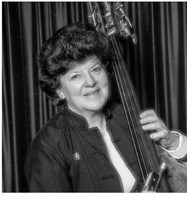
Before there was an OCSM or a Symphony Six, there was a school orchestra in Winnipeg with a problem. “The person who was playing the bass either broke his leg or his arm on the football field,” recalls Ruth Budd, who was a 16-year-old violinist at the time. “The conductor said, ‘Who would volunteer?’ and I said I would! He said, ‘Don’t be silly. You know a girl couldn’t play the bass.’”
This was in the early 1940s, and another sort of person might have believed it to be true or just accepted it as the way of the world. Not Ruth Budd: “I played a violin, and I knew that the strings were just backwards, and I thought, ‘Well, if I just think in negatives, I should be able to do this.’ So I practiced by myself. We entered the festival and won our class. The adjudicator made some comment about it being the first time he’d ever seen a girl playing the bass. Well, I really liked it!”
That was the beginning of an incredible symphonic career for Ruth, which included major contributions to all Canadian orchestras. Over the course of five decades, Ruth became the first female professional bass player in Canada, joining the Toronto Symphony in 1947. She left the TSO in 1952, a casualty of the infamous “Symphony Six” scandal. She then played in the Halifax Symphony and other orchestras before returning to the Toronto Symphony in the mid-1960s. She founded OCSM, together with like-minded colleagues, in the early 1970s. I recently spoke with Ruth by phone, from her home at a seniors’ residence in Toronto. At 89, she speaks with precision and charm, filling her stories and recollections with great warmth.
I first asked Ruth how the Symphony Six scandal came about. “The orchestra had not done much touring, but Ernest [MacMillan, the TSO’s music director] really wanted to. At that time we did not have many guest conductors, neither did we go anywhere very much, if at all.
“I was in the TSO for five years before the McCarthy era really struck and before the opportunities came along for the Symphony to go somewhere. When the invitation came to travel to Detroit for one concert, I think the conductor and the management probably thought this was a glorious opportunity to spread the wonders of the Toronto Symphony! And unless you can fulfill your contract, then you’re out.”
Ruth, of course, was one of those who could not. The six players were denied visas by the U.S. State Department, under suspicion of leftist activities. “The McCarthy era was a terrible time, when nobody had to prove anything. You had only to be suspected of left-leaning and that was enough. As I was walking past the women’s dressing room, I heard one of my colleagues say, ‘Well, she reads a lot so she must be a communist.’ And so on!”
Very little united the six musicians. One was a book lover, another had played in Ukrainian cultural centres: that was Steven Staryk, just 23 at the time, who would later return as the TSO’s concertmaster. Three of the Symphony Six, oddly enough, were bass players.
The story exploded in the papers for weeks, and some members of the TSO board quit in protest. But neither the union nor their fellow musicians did much to support the non-renewed musicians. “They didn’t want to, they were too frightened,” says Ruth. “People were so terrified of losing their jobs that they actually crossed the street in order not to talk to us. One was condemned by association. It was a pretty scary time.”
The dark chapter ends rather quickly though, in Ruth’s telling. “I was very quickly hired to play at one of the local theatres, and I loved it. Here I got a chance to hear and see the great theatre people. I was still aware of the political situation, but I didn’t feel I could do too much about it.”
While she was playing in the theatre, Ruth was also starting a family. “Concerts started at 8, so I could put my kids to bed at 7:30 and go toddling down to the theatre, because I didn’t live that far away. Well it wasn’t wonderful music, but I love theatre and that theatre, the Royal Alex, was great. I also got an awful lot of mending done in the pit.”
I asked Ruth, was mending a hobby she enjoyed? “No, I hated mending. But my kids needed socks and I didn’t have the money to buy them. So I did a lot of fixing down there in the pit.”
Ruth describes with delight how her father altered his car to accommodate her bass: "He cut this door out in the back of the car, and he put a little handle on it, so he could get the bass in the back of the car. I’m pretty sure there wasn’t another one like it; it may have been the first hatchback in Toronto, or in Canada! And he was a portrait photographer, not a metal worker."
That same spirit of resourcefulness wedded to necessity led Ruth into orchestral activism. She joined the Halifax Symphony in 1958, and found conditions there were appalling. “We needed to have enough light. We needed to have enough warmth so that the oboes wouldn’t crack. We needed to make sure that we could see the music, and that it was printed well instead of reading chicken marks, you know? Things just as simple as that. And I’m the kind of person who has a pretty good time wherever I go. I tend to say, ‘Well, how can we make it better?’ That’s just my personality. So I loved being in Halifax and we made some wonderful friends.”
In 1960, Ruth returned to Toronto to perform with the Hart House Orchestra, a celebrated chamber orchestra founded by Boyd Neel, which premiered many new works by Canadian composers. Toronto Symphony music director Walter Susskind heard her play there, and asked her to rejoin the TSO bass section in 1964.
“Right away I became a member of the Players’ Committee, alternating with another very good friend who was a piccolo player, Tony Antonacci. Either he was Secretary and I was President, or he was President and I was Secretary.”
The TSO was a member of the International Conference of Symphony and Opera Musicians (ICSOM), founded in 1962 – another international member was the Montreal Symphony. In the late 60s, Ruth began talking about forming a new, Canadian symphonic player conference: “It seemed to me really important to do that. Because we belonged to the American Federation of Musicians, ICSOM was relevant to the American law. It was not relevant to Canadian law. And we weren’t used to standing up on our own two feet and saying, ‘We can do this. We have another country, we need laws that are relevant to us.’
“And so, in about 1970, I went across the country during my summer holidays. I made contacts in advance and stopped in various cities where there were orchestras. I took the train across the country, which was a wonderful thing to do; I wasn’t in a hurry. I stopped in places like Winnipeg, Saskatoon, Edmonton, Calgary, and Vancouver, and talked to people about the possibility of starting a Canadian group called OCSM. Well, we weren’t sure what we were going to call it, but we thought OCSM would be good.”
The next fall, Ruth and her Canadian symphonic colleagues met for the first time in St. Catharines, even though they had to get permission from their orchestras to attend. “There was a little bit of fear, you know, you never know what you’re doing. And I’ll never forget the sort of fear from the union itself. They thought we were trying to break away! Our meeting was concurrent with the Canadian Conference, and I remember they were sort of pacing up and down and they wanted to know what we were talking about. But we weren’t ready to give a report. And there really wasn’t anything subversive, truly! We were trying to figure out how to make it work better for the Symphonic musicians. We wanted it to become an arm of the union, and to have a fraternal relationship with ICSOM.
“Strangely enough, it sounds as if I got really involved in a lot of the political stuff. You know, I didn’t. I didn’t get involved in the political stuff at work and I didn’t get involved in the political stuff in the union. I got involved in the political stuff that was necessary in the orchestra. So I didn’t hang around and get to know the managers of the orchestra, or even the union officials. The only time I really was involved with them was during the negotiation period.”
I asked Ruth her advice, for those going through tough negotiations today. “We all want the music, so our goal is the same: to have the best orchestra possible within the means of the city. That’s one of my great lines: You want the best orchestra, so do I. In other words, instead of building barriers, break them down.
"Ultimately that’s what you want, the best possible orchestra in that city. How do you get it? How do you attract really good musicians? Offer a really good package. Then we’ll all have what we want.”
Also, find a hobby - preferably something “that you can touch and feel and hold, or eat,” she suggests. “I used to go downstairs where I had a potter’s wheel and a kiln in the basement of my little house, and it was wonderful to work after a concert. If I hated the concert I could come back to joy by creating a pot out of clay, and if I loved the concert, well, that too. I could just work on the pot and love it.”
As positively energized as Ruth gets in recounting her memories, she’s just as enthused about her current projects. These include directing a choir of her fellow seniors at Christie Gardens. (As she firmly points out, she does not conduct.) “We’re thirty-some people and we started out singing ‘Frère Jacques’ and I would say now, we do a reasonably respectable Hallelujah Chorus.” No matter the place or the time, it seems, Ruth Budd finds a way to organize and make music.
Source interview:
Can you tell us a bit about the Symphony Six?
It happened so long ago – I guess that it’s relevant, it’s certainly part of my history.
Symphony Six happened in the early 60s?
No, it was actually the early 50s. Makes a difference.
And you had just joined the Toronto Symphony at the time?
No, I had joined 5 years earlier.
And the orchestra was touring to the States?
Well, the orchestra had not done much touring and we had had very few guest conductors. And I think Ernest [MacMillan, the TSO’s music director] really wanted to. We did not at that time have many guests, neither did we go anywhere very much. If at all – if I recall, we didn’t even service our own country, which I thought at the time was a mistake. But I was pretty excited about being in the orchestra, I was only in my early 20s so, stardust, etc.
That must have a pretty heady time.
Yeah, it was. However, I was in for 5 years before the McCarthy era really struck and before the opportunities came along for the Symphony to go somewhere. You know, the Concertgebuow Orchestra at the time had set quite a precedent. They were invited to go on tour and [Music Director ?] van Bidem said the whole orchestra goes, or nobody goes. But that was they, and they had a whole history and I guess they were pretty secure. Whereas I think we weren’t, including Sir Ernest. So when our opportunity came along to travel to Detroit for one concert, I think the conductor and the management probably thought this was a glorious opportunity to spread the wonders of the Toronto Symphony and we want to do it! And unless you can fulfill your contact, then you’re out.
Well for whatever reason, there were six of us who could not get into the States. One including Steven Staryk, one including a book lover… At that time, the McCarthy era was a terrible time when you didn’t have to prove anything, and nobody had to prove anything. I mean, what were you proving? That you had a different belief or philosophical leanings, and so that didn’t make you a good enough musican. That’s really what it came down to. And that a foreign element was dictating who can be in our orchestra! So there were some very mixed feelings.
Was Steven Staryk the concertmaster?
No, he was very young. As I was 23, and he was younger than I was.
Were all of the 6 quite young?
No, I don’t think so. It was a real mix. Although I think there were 2 or 3 bass players, I don’t know what that was about! And so anyhow, that was the situation. And people were so terrified of their jobs that they actually crossed the street in order not to talk to us. So it was condemned by association. It was a pretty scary time.
So the orchestra went on tour without you. How long did the situation last? Were you ever able to travel to the States?
Of course I was in much later years, and of course I didn’t really have any desire to. What happened was, I lost my job in the symphony, and the six of us did. There was quite a local uproar. To quote them, we weren’t fired – we just didn’t have our contracts renewed. Well, it comes down to the same thing, you don’t have a job, right?
Was there any union protection or grievance?
None whatsoever. The union totally supported management. I would say that the union did not do its job of protecting and supporting the players. They were totally in the hands of management.
And your fellow musicians couldn’t do much either.
They didn’t want to, they were too frightened.
Was this a point where you realized we needed stronger unions?
I’m not sure that was the epiphany at that point. When you’re hurting, you’re hurting very personally, but you realize that it is a reflection of the times. I didn’t know what the answer was, I knew only that the union was not supporting us. Maybe one or two people on the board supported us. But the headlines in the local paper lasted weeks. It was quite a controversy in the city, and people quit the Symphony board in support of us, and there was a movement afoot to support the Symphony Six.
I realized certainly it was the times, the McCarthy era was upon us in the States, people were being blacklisted right and left, and for your beliefs or non-beliefs – they were not correctly right in the case of the Symphony Six – it doesn’t matter. That was just the times, and I think that for me I was very quickly hired to play at one of the local theatres, and I loved it. Because I loved going to the theatre and here I got the chance to hear and see the great people coming into town. I was still aware of the political situation, but I didn’t feel I could do too much about it.
How long until you rejoined the Toronto Symphony?
I would say it was about 12 years. Different management, different conductor who heard me playing in the Hart House Orchestra with Boyd Neal. This was a wonderful chamber orchestra, and Boyd Neal was famous throughout the world. He had the Boyd Neal Chamber Orchestra in London. He was actually a medical doctor but he couldn’t stand the sight of blood. And he loved and was very good at conducting. And he even had lots of music written for his chamber group in England.
I can’t remember who the conductor was, probably Susskind, and he heard the Boyd Neal Chamber Orchestra playing, and I was the only bass. And he said, “How come you’re not in the symphony?” and I told him the story and he said, “Well, I want you back in there.”
So that was twelve years later, during which time I’d had two kids. And I actually loved my job at the theatre because I loved going to theatre and it was a cinch of a job.
Did you ever miss that work later?
When I came in, of course I left the Royal Alex. I liked what I was doing, but of course it wasn’t much of a challenge. You go in early and play the music at the beginning, at the intermission, and a chaser. Well it wasn’t very wonderful music, but the theatre was great. And so I enjoyed that while I was doing that, got an awful lot of mending done in the pit and I could put my kids to bed at 7:30, concerts started at 8. Put the kids to bed, and go toddling down to the theatre because I didn’t live that far away from it.
How rare was it to be a woman orchestral musician at the time?
Well, it might not have been so rare to be a violinist. There were quite a few violinists and viola players. But there were no double bass players. I think I might have been the first professional woman bass player in Canada. I think so. And my father, who had a little car, in order to accommodate my bass, cut out a door in the back of his car. And I think he made the first hatchback in Toronto, or in Canada!
He was wonderful, he really was very encouraging, and my mother wasn’t too sure but my father said, “Just do whatever you want to do, if you can.” And he loved music. So he cut this door out in the back of the car, and he put a little handle on it, so he could get the bass in the back of the car. Snd I’m pretty sure there wasn’t another one like it.
Do you have any pictures of the car?
No, just in my mind. And I see him cutting it out with one of those torches that cut metal…
Was he a metal worker?
No! He was a first-rate portrait photographer. You could get someone to draw a cartoon. But my father was not a metal worker, but that didn’t stop people in those days. You read about it, or you figured out something to do. And I must say I think that at least I and a couple of other people in my family, my sons for one, have this sort of creative spirit, “here’s what you can do to make it work” sort of thing. Might be unconventional, but it’s certainly fun.
Anyhow, I think that the first time I played the bass publicly was when I was 16. And what happened was, I was in the school orchestra, we used to have wonderful school orchestras in those days. And we were going to enter the festival, and we also did a program of Gilbert and Sullivan every year. There were pretty good players. And the person who was playing the bass I think either broke his leg or his arm on the football field. And the conductor said, “Who would volunteer?” and I said I would! And he said don’t be silly, you know a girl couldn’t play the bass.
I played a violin, and I knew that the strings were just backwards, and I thought well, if I just think in negatives, I should be able to do this. So I practiced by myself, and we entered the festival, and we won our class. And whoever it was made some comment about the first time he’d ever seen a girl playing the bass. Well, I really liked it!
That’s wonderful.
It really was wonderful! And then I found someone to give me lessons, and he was a wonderful old guy who used to play the bass. And he was quite old, but he told me things like using gut strings you had to cut a walnut in half and use the walnut oil on the strings, which would keep them from rattling or something. Wonderful old guy.
This was in Manitoba, by the way, that I started. I grew up in Winnipeg until I was about 16 and then I left for Vancouver. And so, I think that at 16 you’re developing an identity of some kind, and I was developing mine, and that’s what I did. And joined every orchestra I could think of, the provincial youth orchestra and whatever, in order to learn how to play. And I heard some orchestra, it might have been the Philadelphia under Stokowski, and they played the Bach Toccata and Fugue, and that just made me absolutely wild with joy! And I thought, “I have to do that. That’s what I have to do.”